Biker metal
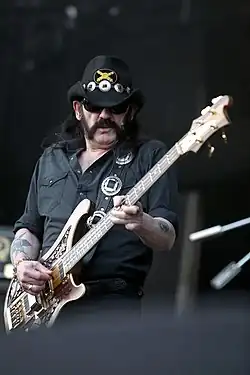
| Origines culturelles | Fin des années 1970, début des années 1980 ; États-Unis et Royaume-Uni |
|---|---|
| Instruments typiques | Voix, batterie, basse |
| Voir aussi | Glam metal, street punk, thrash metal, NWOBHM, doom metal, stoner metal, grunge, punk blues |
Genres dérivés
Le biker metal (litt. metal de biker, également connu sous le nom de biker punk) est un genre fusion mêlant des éléments de punk rock, heavy metal, rock 'n' roll et blues, dont les pionniers sont Motörhead, Plasmatics, Anti-Nowhere League et Girlschool, entre la fin des années 1970 et le début des années 1980, en Angleterre et aux États-Unis.
Terminologie
L'association avec la culture motarde est présente pendant la majeure partie de la vie du heavy metal et du punk rock : Thin Lizzy est photographié fréquemment avec des motos dès 1973 ; Joan Jett fait la couverture du Outlaw Biker Magazine ; Judas Priest utilise une image de motard à partir du milieu des années 1970, mais a aussi beaucoup emprunté au sadomasochisme[1],[2],[3] ; et le style vestimentaire des metalleux est étroitement lié à celui des gangs de motards[4]. Spin salue Lemmy, le leader de Motörhead, comme le premier à avoir introduit la culture de la moto dans le punk rock et le heavy metal, probablement sous l'influence de groupes de rock antérieurs tels que Steppenwolf, Lynyrd Skynyrd et Grateful Dead[3]. Une des premières utilisations du terme « heavy metal » est même présente dans le morceau Born to Be Wild de Steppenwolf (1968), en référence à une moto[5].
Caractéristiques
Le biker metal est décrit comme étant influencé par le punk rock, le rock 'n' roll, le heavy metal[6],[7] et le blues[8]. Sleazegrinder, rédacteur de Classic Rock, décrit le biker metal comme du « glam metal à la Mad Max »[9].
Le biker metal se caractérise par son approche mid-tempo du metal, son style « grinçant et américain » et son alignement sur la culture biker dans son ensemble[10]. Le genre est opposé à des formes de metal plus lentes et plus opératiques, comme les morceaux de Judas Priest au début des années 2000[11]. Le genre est opposé à des formes de metal plus lentes et plus opératiques, comme le travail de Judas Priest au début des années 2000. De même, le biker metal renonce à la vitesse et à la virtuosité qui ont pris de l'importance dans les années 1980[12].
Des groupes tels que Black Moth, Orange Goblin, The Obsessed, Earthride et Black Label Society sont décrits comme fusionnant le style avec le doom metal[13],[14],[15],[16],[17], tandis que Clutch est décrit comme fusionnant des éléments de biker metal et de rock sudiste dans son son stoner rock[18]. Le morceau Paranoid de Black Sabbath est considérée comme un classique du genre[19],[20].
Le biker metal a une influence sur des genres allant du speed metal au punk hardcore et au crust punk, et fait partie intégrante du développement du metal extrême[6],[21]. Giuseppe Sbrana du groupe de heavy metal botswanais Skinflint déclare que les groupes de biker metal ont eu une grande influence sur l'esthétique des groupes de heavy metal africain[22].
Notes et références
- (en) Cet article est partiellement ou en totalité issu de l’article de Wikipédia en anglais intitulé « Biker metal » (voir la liste des auteurs).
- ↑ (en) Andrew L. Cope, Black Sabbath and the Rise of Heavy Metal Music, Routledge, .
- ↑ (en) Gerd Bayer, Heavy Metal Music in Britain, p. 136
- 1 2 Donna Gaines, « Biker Metal », Spin, ..
- ↑ (en) Amber R. Clifford-Napoleone, Queerness in Heavy Metal Music: Metal Bent, p. 33.
- ↑ (en) Ray Broadus Browne et Pat Browne, The Guide to United States Popular Culture, p. 373.
- 1 2 (en) Martin Popoff, Speed Metal, .
- ↑ (en) Donna Gaines, Teenage Wasteland: Suburbia's Dead End Kids, p. 191.
- ↑ (en) Jon Wiederhorn, « 39 years ago: Motorhead paved the way for Thrash with second album 'overkill' », sur Loudwire, (consulté le ) : « With their 1977 self-titled debut, Motörhead opened the floodgates for a new style of bluesy, bombastic biker metal, but two years later, on March 24, 1979, they rewrote the rule book altogether with the more urgent, combustive Overkill. »
- ↑ (en) Sleaze Grinder, « Flash Metal Suicide: Steve Jones », sur Classic Rock, (consulté le ), So naturally, Jones wanted to keep the motor revving. And as we rolled into the last gasp of the 80s, biker metal was where it was at. COP, Warrior Soul, Zodiac Mindwarp, Spread Eagle, Horse London, Two Bit Thief, The Cult, Four Horsemen, I mean, everybody had long hair and dangling earrings and black biker boots and snorted whiskey and guzzled gasoline in '89. Biker metal was glam metal gone Mad Max, basically, and 1989 was truly the Year of Manly Living..
- ↑ (en) Dan Epstein, Richard Bienstock, Hank Shteamer, Christopher Krovatin, Cory Grow et Joseph Hudak, « Motorhead's Lemmy: 20 Essential Songs », sur Rolling Stone, (consulté le ), A herald of the laid-back biker metal of the band's latter years, "Born to Raise Hell" is a Motörhead classic lacking any pretense.
- ↑ (en) Joel McIver, The 100 Greatest Metal Guitarists, Jawbone Press, (ISBN 9781906002206, lire en ligne), p. 120.
- ↑ Joel McIver, To Live is to Die: The Life and Death of Metallica's Cliff Burton, Jawbone Press, (ISBN 9781906002244, lire en ligne), p. 85
- ↑ (en) Richard Bienstock, « 25 Most Anticipated Metal Albums of 2016 », sur Rolling Stone (consulté le ) : « Former Ozzy Osbourne guitar man Zakk Wylde spends most of his time these days churning out doomy biker metal with Black Label Society »
- ↑ (en) Malcolm Dome, « Orange Goblin/Karma To Burn/Black Moth at Electric Ballroom, London live review », sur Classic Rock, (consulté le ).
- ↑ (en) Kim Kelly, « Live: A Week in Metal at SXSW », sur The Fader (consulté le ).
- ↑ (en) Sam Law, « six things we learned at desertfest 2018 », sur Kerrang!, (consulté le ).
- ↑ (en) Miranda Yardley, « band of the Day: Biker Domom Lords Earthride », sur Terrorizer, (consulté le ).
- ↑ (en) Ken McIntyre, « How Clutch threw out the rules and made metal music their own », sur Classic Rock, (consulté le ).
- ↑ (en) Richard Bienstock, « See type o negative's massive, melancholic live cover of Black Sabbath's "Paranoid" », (consulté le ), Seeing as Type O Negative are the band that brought heavy-metal doom to goth rock, it's no surprise that they were huge Sabbath fans. And while their best-known Sabbath cover is "Black Sabbath," from the original '94 Nativity in Black tribute album, a few years earlier (it was tacked on as a bonus cut to 1992's "live" album The Origin of the Feces) they took on the Sab's biker-metal classic "Paranoid," turning into a very Type O–esque dirge.
- ↑ (en) Richard Bienstock, « 10 Epic Live Black Sabbath Covers », sur Guitar World, (consulté le ), And while their best-known Sabbath cover is "Black Sabbath," from the original '94 'Nativity in Black' tribute album, a few years earlier (it was tacked on as a bonus cut to 1992's "live" album 'The Origin of the Feces') they took on the Sab's biker metal classic "Paranoid," turning into a very Type O-esque dirge.
- ↑ (en) E.R. Smith, Extreme Metal: The Story of Punk and Metal's Interwoven History.
- ↑ (en) Frank Marshall, « Botswana's Cowboy Metalheads », sur Vice Media, (consulté le ) : « Also many metalheads in Botswana are cowboys from the villages and farms, so they mix the cowboy image with a biker metal look ».
 Portail du metal