Cochlicopa lubrica
Brillante commune
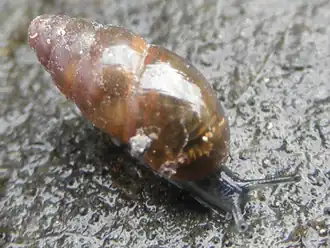
| Règne | Animalia |
|---|---|
| Embranchement | Mollusca |
| Classe | Gastropoda |
| Sous-classe | Heterobranchia |
| Infra-classe | Euthyneura |
| Subter-classe | Tectipleura |
| Super-ordre | Eupulmonata |
| Ordre | Stylommatophora |
| Sous-ordre | Helicina |
| Infra-ordre | Pupilloidei |
| Super-famille | Pupilloidea |
| Famille | Cochlicopidae |
| Genre | Cochlicopa |
Cochlicopa lubrica, la Brillante commune, est une espèce d'escargots terrestres à respiration aérienne, un gastéropode pulmoné de la famille des Cochlicopidae.
Description
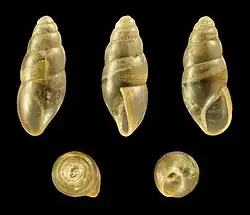
La coquille, mesurant de 5 à 7,5 mm de long sur 2,4 à 2,9 mm de large, présente quatre à cinq spires modérément convexes[1]. L’ouverture est légèrement épaissie à l’intérieur[1]. Il n’y a pas de dents dans l’ouverture, ni d’ombilic[1]. La coquille est de couleur brun jaunâtre à brun rougeâtre corné[1]. L’animal est grisâtre à noirâtre, avec des tentacules foncés[1].
Cette espèce peut être difficile à distinguer de l’espèce similaire Cochlicopa lubricella[1].
Répartition
Cette espèce se rencontre notamment en Espagne, en Grande-Bretagne, en Hongrie, en Irlande, aux Pays-Bas, en Pologne[2], en Slovaquie, en Tchéquie et en Ukraine[3].
Dénominations
Ce taxon porte en français le nom vernaculaire ou normalisé suivant : Brillante commune[4].
Taxonomie
Cochlicopa repentina Hudec, 1960 a été considérée comme une forme de Cochlicopa lubrica en 1994[5].
Le nom valide complet (avec auteur) de ce taxon est Cochlicopa lubrica (Müller, 1774)[6].
L'espèce a été initialement classée dans le genre Helix sous le protonyme Helix lubrica O. F. Müller, 1774[6].
Cochlicopa lubrica a pour synonymes[6] :
- Bulimus subcylindricus var. albinos Moquin-Tandon, 1856
- Bulimus subcylindricus var. fuscus Moquin-Tandon, 1856
- Cionella (Zua) lubrica var. sinistrorsa Goldfuss, 1900
- Cionella lubrica var. pfeifferi Weinland, 1874
- Cochlicopa lubrica var. hyalina Jeffreys, 1862
- Ferussacia subcylindrica var. grisea Locard, 1880
- Ferussacia subcylindrica var. opaca Locard, 1880
- Achatina lubrica (O. F. Müller, 1774)
- Bulimus lubricoides W. Stimpson, 1851
- Bulimus lubricus (O. F. Müller, 1774)
- Bulimus maderensis R. T. Lowe, 1852
- Bulimus nitidissimus Krynicki, 1833
- Bulimus subcylindricus Moquin-Tandon, 1856
- Cionella (Ferussacia) lubrica (O. F. Müller, 1774)
- Cionella (Zua) lubrica (O.F. Müller, 1774)
- Cionella columna Clessin, 1875
- Cionella lubrica (O. F. Müller, 1774)
- Cionella pfeifferi Weinland, 1874
- Cionella subcylindrica W. G. Binney, 1869
- Cochlicopa (Cochlicopa) lubrica (O. F. Müller, 1774)
- Cochlicopa (Cochlicopa) pfeifferi (Weinland, 1874)
- Cochlicopa (Cochlicopa) repentina Hudec, 1960
- Cochlicopa (Zua) lubrica (O.F. Müller, 1774)
- Cochlicopa repentina Hudec, 1960
- Ferussacia subcylindrica (Moquin-Tandon, 1856)
- Helix lubrica O. F. Müller, 1774
- Helix lubricus O. F. Müller, 1774
- Helix stagnorum Gmelin, 1791 sensu Pulteney, 1799
- Physa aenigma Westerlund, 1877
- Turbo glaber da Costa, 1778
- Zua buddii Dupuy, 1849
- Zua locardi Pollonera, 1885
- Zua lubrica (O. F. Müller, 1774)
Liens externes
- (en) Myers, P. et al., Animal Diversity Web : Cochlicopa lubrica, 2025 (consulté le )
- (en) Catalogue of Life : Cochlicopa lubrica (O. F. Müller, 1774) (consulté le )
- (fr + en) EOL : Cochlicopa lubrica (consulté le )
- (fr + en) GBIF : Cochlicopa lubrica (O.F.Müller, 1774) (consulté le )
- (fr) INPN : Cochlicopa lubrica (O.F. Müller, 1774) (TAXREF) (consulté le )
- (en) IRMNG : Cochlicopa lubrica (O. F. Müller, 1774) (consulté le )
- (fr + en) ITIS : Cochlicopa lubrica (Muller, 1774) (consulté le )
- (en) NCBI : Cochlicopa lubrica (taxons inclus) (consulté le )
- (en) OEPP : Cochlicopa lubrica (Müller) (consulté le )
- (en) Taxonomicon : Cochlicopa lubrica (Müller, 1774) (consulté le )
- (en) WoRMS : espèce Cochlicopa lubrica (O. F. Müller, 1774) (consulté le )
- Cochlicopa lubrica sur Animalbase : taxonomie, description succincte, répartition, biologie, statut (menaces), images.
- "Cionella lubrica (Müller, 1774): Glossy Pillar". Gastéropodes terrestres du bassin de Columbia, Colombie-Britannique.
- "Cionella lubrica (Muller), Glossy pillar snail – Biodiversity of Great Smoky Mountains National Park".
Bibliographie
- Müller, O. F. (1774). *Vermium terrestrium et fluviatilium...* vol. 2, Heineck et Faber, Copenhague & Leipzig.
- Westerlund, C.A. (1877). *Sibiriens Land- och Sötvatten-Mollusker*. Kongliga Svenska Vetenskaps-Akademiens Handlingar, 14(12): 1-111.
- Stimpson, W. (1851). *Shells of New England...*. Boston: Phillips, Sampson and Company.
- Barker, G. M. (1999). Naturalised terrestrial Stylommatophora (Mollusca: Gastropoda). Fauna of New Zealand 38: 1-254.
- Spencer, H.G., Marshall, B.A. & Willan, R.C. (2009). Checklist of New Zealand living Mollusca. pp. 196–219 in Gordon, D.P. (ed.) New Zealand inventory of biodiversity. Volume one. Kingdom Animalia: Radiata, Lophotrochozoa, Deuterostomia. Canterbury University Press, Christchurch.
- Herbert, D.G. (2010). The introduced terrestrial Mollusca of South Africa. SANBI Biodiversity Series, 15: vi + 108 pp. Pretoria.
- Kerney, M.P., Cameron, R.A.D. & Jungbluth, J-H. (1983). *Die Landschnecken Nord- und Mitteleuropas. Ein Bestimmungsbuch für Biologen und Naturfreunde*, 384 pp., 24 planches. Hambourg / Berlin (Paul Parey).
- Sysoev, A. V. & Schileyko, A. A. (2009). *Land snails and slugs of Russia and adjacent countries*. Sofia/Moskva (Pensoft). 312 pp., 142 planches.
- Yen, T.-C. (1939). *Die chinesischen Land- und Süßwasser-Gastropoden des Natur-Museums Senckenberg*. Abhandlungen der Senckenbergischen Naturforschenden Gesellschaft, 444: 1-233, pl. 1-16. Francfort-sur-le-Main.
- Minato, H. (1988). *A systematic and bibliographic list of the Japanese land snails*. H. Minato, Shirahama, 294 pp., 7 planches.
- National Institute of Biological Resources. (2019). *National Species list of Korea. II. Vertebrates, Invertebrates, Protozoans*. Designzip. 908 pp.
Notes et références
- (en) Cet article est partiellement ou en totalité issu de l’article de Wikipédia en anglais intitulé « Cochlicopa lubrica » (voir la liste des auteurs).
- 1 2 3 4 5 6 (de) M. P. Kerney, R.A.D. Cameron et J.H. Jungbluth, Die Landschnecken Nord- und Mitteleuropas, Paul Parey, Hambourg, 1999, 384 pages (ISBN 978-3490179180).
- ↑ (pl) Jadwiga Anna Barga, « Wyniki Wstępnych Badań Do Monitoringu Malakofauny Zlewni „Pożary” W Kampinoskim Parku Narodowym » [PDF], sur Kampinoski-pn.gov.pl (consulté le )
- ↑ (en) I. Balashov et N. Gural-Sverlova, « An annotated checklist of the terrestrial molluscs of Ukraine », Journal of Conchology, 2012, vol. 41, n. 1, p. 91–109.
- ↑ MNHN & OFB [Ed]. 2003-présent. Inventaire national du patrimoine naturel (INPN), Site web : https://inpn.mnhn.fr, consulté le 24 avril 2025.
- ↑ (en) G. Armbruster et M. Schlegel, « The land-snail species of Cochlicopa (Gastropoda: Pulmonata: Cochlicopidae): presentation of taxon-specific allozyme patterns, and evidence for a high level of self-fertilization », Journal of Zoological Systematics and Evolutionary Research, 1994, vol. 32, p. 282–296 (lire en ligne).
- 1 2 3 World Register of Marine Species, consulté le 24 avril 2025.
 Portail des mollusques et de la malacologie
  Portail de l’Europe