Euctenochasmatia
Groupes de rang inférieur
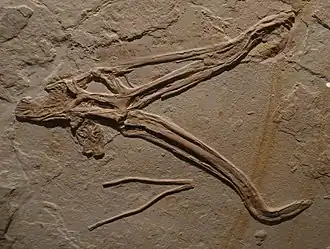
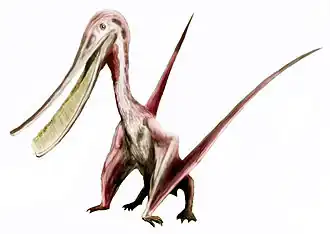
Les Euctenochasmatia forment un clade de ptérodactyloïdes archaeoptérodactyloïdes. Ce sont des ptérosaures, un groupe éteint de « reptiles ailés »[1].
Ils ont vécu du Jurassique supérieur jusqu'à la fin du Crétacé inférieur et leurs fossiles ont été découverts en Europe, en Asie et en Afrique[2].
Définition
Le clade des Euctenochasmatia a été défini en 2003 par David Unwin, comme le groupe qui inclut le dernier ancêtre commun de Pterodactylus kochi et Ctenochasma ainsi que tous leurs descendants[3].
Classification
Le cladogramme ci-dessous montre les résultats de l'étude phylogénétique réalisée en 2018 par Longrich, Martill et Andres. Il intègre la description du genre Kryptodrakon[4],[1] :
| Pterodactyloidea |
| ||||||||||||||||||||||||||||||||||||||||||
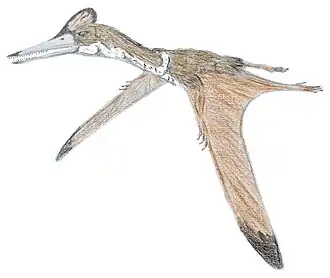
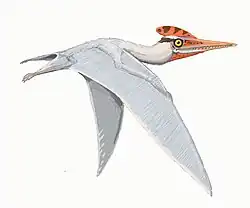
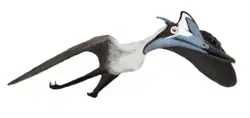
L'analyse de 2017 réalisée par Steven Vidovic et David Martill, avant la description de Kryptodrakon était sensiblement différente, en particulier pour les ptérodactyloïdes basaux et la position du clade des Lophocratia[5] :
| Pterodactyloidea |
| ||||||||||||||||||||||||||||||
Voir aussi
Liens externes
- Ressource relative au vivant :
Notes et références
Références taxonomiques
Références
- 1 2 (en) Longrich NR, Martill DM, Andres B, « Late Maastrichtian pterosaurs from North Africa and mass extinction of Pterosauria at the Cretaceous-Paleogene boundary », PLoS Biology, vol. 16, no 3, , e2001663 (PMID 29534059, PMCID 5849296, DOI 10.1371/journal.pbio.2001663)
- ↑ (en) Richard J. Butler, Stephen L. Brusatte, Brian B. Andres et Roger B. J. Benson, « How do geological sampling biases affect studies of morphological evolution in deep time? A case study of the Pterosauria (Reptilia: Archosauria) », Evolution, vol. 66, no 1, , p. 147–162 (PMID 22220871, DOI 10.1111/j.1558-5646.2011.01415.x)
- ↑ (en) Unwin, D., 2003. "On the phylogeny and evolutionary history of pterosaurs", in Evolution and Palaeobiology of Pterosaurs, Geological Society London Special Publications 217(1), 139–190
- ↑ (en) B. Andres, J. Clark et X. Xu, « The Earliest Pterodactyloid and the Origin of the Group », Current Biology, (DOI 10.1016/j.cub.2014.03.030)
- ↑ (en) S.U. Vidovic et D.M. Martill, « The taxonomy and phylogeny of Diopecephalus kochi (Wagner, 1837) and "Germanodactylus rhamphastinus" (Wagner, 1851) », Geological Society, London, Special Publications, vol. 455, , p. 125–147 (DOI 10.1144/SP455.12, lire en ligne)
 Portail des ptérosaures