Khanats du Caucase
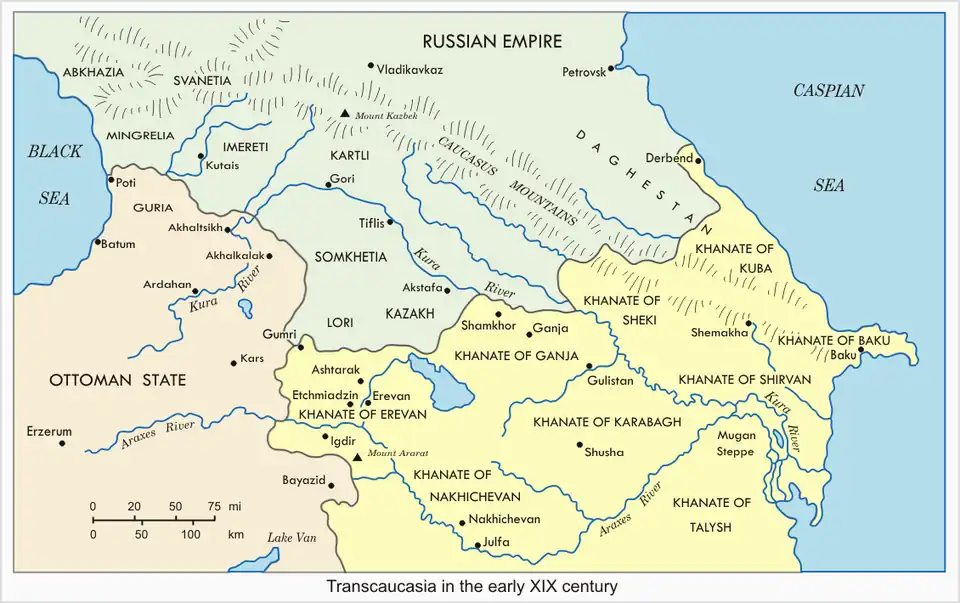
Les khanats du Caucase ou, rarement et anachroniquement, les khanats azerbaïdjanais[1],[2] (du fait que certains de ces khanats furent créés sur le territoire de l'actuelle république d'Azerbaïdjan, mais qu'il ne faut pas confondre avec les khanats d'Azerbaïdjan historiques), étaient diverses provinces et principautés[3] établies dans les territoires caucasiens de l'Empire afcharide (actuels république d'Azerbaïdjan, Arménie, Géorgie et Daghestan) après la mort de Nader Chah en 1747, en même temps que les khanats d'Azerbaïdjan voisins. Les khanats du Caucase étaient pour la plupart gouvernés par des khans d'origine turque (azérie du Caucase)[4],[5],[6] et étaient des vassaux et des sujets du chah iranien[7]. Les khans n'avaient ni unité territoriale ou religieuse, ni identité ethnique/nationale. Ils étaient surtout intéressés à conserver leurs positions et leurs revenus.[8]
Les khanats du Caucase furent perdus par la Perse qadjare au profit de l’Empire russe à la suite de la guerre russo-persane de 1804-1813.
Liste des khanats du Caucase
- Liste des khanats du Caucase[9]
- Khanat de Bakou
- Khanat de Gandja
- Khanat de Derbent (en)
- Khanat du Karabagh
- Khanat de Kouba
- Khanat de Nakhitchevan
- Khanat de Talysh (en)
- Khanat de Chaki
- Khanat d'Erevan
- Khanat de Chirvan
Les références
- ↑ Batalden, Stephen K. (1997), The Newly Independent States of Eurasia, Greenwood Publishing Group, p. 110, The 1812 Treaty of Gulistan and the 1828 Treaty of Turkmanchai ended the two Russo-Persian wars and brought Azerbaijani khanates north of the Aras River under Russian control.
- ↑ Robert Strausz-Hupé, Harry W. Hazard. The idea of colonialism. Praeger, 1958. P. 77.
In 1804 Russian troops occupied the khanate of Ganja, and this was followed by the surrender of several other autonomous Azeri khanates in western Azerbaijan.
- ↑ George Bournoutian. The Khanate of Erevan Under Qajar Rule: 1795-1828. (Mazda Publishers, 1992), p. xxiii; "The term khanate refers to an area that was governed by hereditary or appointed governors with the title of khan or beglerbegi who performed a military and/or administrative function for the central government. By the nineteenth century, there were nine such khanates in Transcaucasia (...)"
- ↑ World and Its Peoples : Middle East, Western Asia, and Northern Africa, Marshall Cavendish Corporation, , 1712 p. (ISBN 0761475710, lire en ligne), « The Azeris », p. 751
« In a series of wars with Persia at the beginning of the nineteenth century, Russia gained the Azeri khanates north of the Araks River, which still forms the frontier between Azerbaijan and Iran. »
- ↑ Russian Azerbaijan, 1905–1920 By Tadeusz Swietochowski page 272
- ↑ Russia and Iran, 1780-1828 By Muriel Atkin, Page 16-20
- ↑ Encyclopedia of Soviet law, Ferdinand Joseph Maria Feldbrugge, Gerard Pieter van den Berg, William B. Simons, p. 457
- ↑ Bournoutian 2016, p. 120.
- ↑ Bournoutian 2016, p. 11; Bournoutian 2021, p. 107–108
Sources
- George Bournoutian, « Prelude to War: The Russian Siege and Storming of the Fortress of Ganjeh, 1803–4 », Taylor & Francis, vol. 50, no 1, , p. 107–124
- (en) George Bournoutian, From the Kur to the Aras : A Military History of Russia's Move into the South Caucasus and the First Russo-Iranian War, 1801–1813, Leiden, Brill, , 366 p. (ISBN 978-9004445154)
.svg.png) Portail de l’Iran et du monde iranien
Portail de l’Iran et du monde iranien  Portail de l’Azerbaïdjan