Steatoda nobilis
| Règne | Animalia |
|---|---|
| Embranchement | Arthropoda |
| Sous-embr. | Chelicerata |
| Classe | Arachnida |
| Ordre | Araneae |
| Sous-ordre | Araneomorphae |
| Famille | Theridiidae |
| Genre | Steatoda |
- Lithyphantes nobilis Thorell, 1875
- Steatoda clarkii O. Pickard-Cambridge, 1879
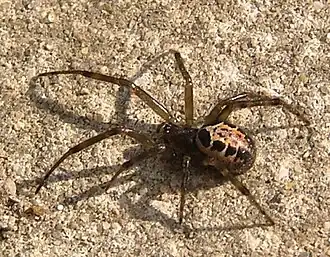
Steatoda nobilis est une espèce d'araignées aranéomorphes de la famille des Theridiidae[1].
Elle est communément appelée Fausse Veuve noire.
Distribution
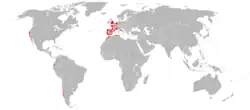
Cette espèce est originaire des îles Canaries et de Madère[1].
Elle a été introduite[1],[2] au Portugal[3], en Espagne[3], en France[4], en Grande-Bretagne[5], en Irlande[6], en Belgique[7], aux Pays-Bas[8], en Allemagne[9], en Suisse[10], en Italie[11], en Grèce[12], en Turquie[13], en Algérie[14], au Maroc[4], au Chili[15], en Équateur[9], en Colombie[16] et aux États-Unis en Californie[17].
Description

Le mâle syntype mesure 10 mm[18].
Les mâles mesurent de 7,8 à 10,6 mm et les femelles de 9,5 à 14 mm[2].
Des morsures sérieuses ont été observées[19].
Systématique et taxinomie
Cette espèce a été décrite sous le protonyme Lithyphantes nobilis par Thorell en 1875. Elle est placée dans le genre Teutana par Jackson en 1907[20] puis dans le genre Steatoda par Levi en 1957[21].
Steatoda clarkii[22] a été placée en synonymie.
Galerie
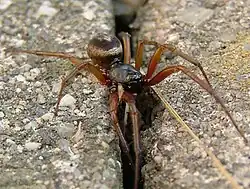
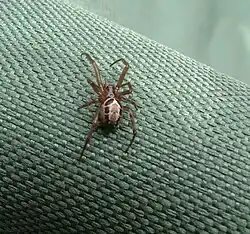 Steatoda nobilis
 Mâle avec ses pédipalpes
 Steatoda nobilis
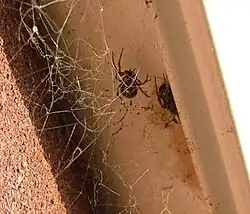 Toile de Steatoda nobilis
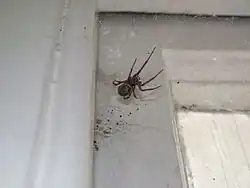 Steatoda nobilis sur sa toile

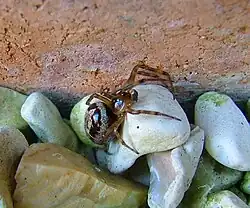
Steatoda nobilis qui mange une coccinelle asiatique après l'avoir attrapée dans sa toile et lui avoir injecté son venin à Lille en France.
Publication originale
- Thorell, 1875 : « Descriptions of several European and North African spiders. » Bihang till Kongliga Svenska Vetenskaps-Akademiens Handlingar, vol. 13, no 5, p. 1-203.
Liens externes
- (en) Myers, P. et al., Animal Diversity Web : Steatoda nobilis, 2025 (consulté le )
- (en) BioLib : Steatoda nobilis (Thorell, 1875) (consulté le )
- (en) Catalogue of Life : Steatoda nobilis (Thorell, 1875) (consulté le )
- (fr + en) EOL : Steatoda nobilis (Thorell 1875) (consulté le )
- (fr + en) GBIF : Steatoda nobilis (Thorell, 1875) (consulté le )
- (fr) INPN : Steatoda nobilis (Thorell, 1875) (TAXREF) (consulté le )
- (en) IRMNG : Steatoda nobilis (consulté le )
- (fr + en) ITIS : Steatoda nobilis (Thorell, 1875) (consulté le )
- (en) NCBI : Steatoda nobilis (taxons inclus) (consulté le )
- (en) Taxonomicon : Steatoda nobilis (Thorell, 1875) (consulté le )
- (en) World Spider Catalog : Steatoda nobilis (Thorell, 1875) dans la famille Theridiidae +base de données (consulté le )
- Naturdata - Steatoda nobilis
Notes et références
- 1 2 3 World Spider Catalog (WSC). Musée d'histoire naturelle de Berne, en ligne sur http://wsc.nmbe.ch. doi: 10.24436/2, consulté lors d'une mise à jour du lien externe.
- 1 2 araneae
- 1 2 Branco, Morano & Cardoso 2019 : « An update to the Iberian spider checklist (Araneae). » Zootaxa, no 4614, p. 201-254.
- 1 2 Emerit & Ledoux, 2013 : « De araneis Galliae III. 5 Steatoda nobilis (Thorell, 1875) en Europe. » Revue Arachnologique, vol. 17, p. 92-93.
- ↑ Snazell & Jones, 1993 : « The theridiid spider Steatoda nobilis (Thorell, 1875) in Britain. » Bulletin British Arachnological Society, vol. 9, no 5, p. 164–167.
- ↑ Cawley, 2001 : « Distribution records for uncommon spiders (Araneae) including five species new to Ireland. » Bulletin of the Irish Biogeographical Society, vol. 25, p. 135-143.
- ↑ Van Keer, 2011 : « An update on the verified reports of imported spiders (Araneae) from Belgium. » Nieuwsbrief van de Belgische Arachnologische Vereniging, vol. 25, no 3, p. 210-214.
- ↑ van Helsdingen, 2015 : « Binnenwandelende exoten. » Nieuwsbrief SPINED, vol. 35, p. 33-34.
- 1 2 Bauer, Feldmeier, Krehenwinkel, Wieczorrek, Reiser & Breitling, 2019 : « Steatoda nobilis, a falsewidow on the rise: a synthesis of past and current distribution trends. » NeoBiota, vol. 42, p. 19-43.
- ↑ Loria, 2023 : « Cinq premières et une deuxième mentions d’araignées pour la Suisse (Araneae). » Entomo Helvetica, vol. 16, p. 123-136.
- ↑ Kulczycki, Legittimo, Simeon & Di Pompeo, 2012 : « New records of Steatoda nobilis (Thorell, 1875) (Araneae, Theridiidae), an introduced species on the Italian mainland and in Sardinia. » Bulletin of the British Arachnological Society, vol. 15, p. 269-272.
- ↑ Bosmans & Gavalas, 2023 : « The spiders (Araneae) of the tiny Greek island Iraklia (Kiklades), with the descriptions of 5 new Harpactea species (Araneae: Dysderidae), 3 species new to Europe and 8 new to Greece. » Parnassiana Archives, vol. 11, Supplementum no 1, p. 1-91.
- ↑ Danışman, Kunt & Özkütük, 2022 : « The checklist of the spiders of Turkey. » Version 2022.
- ↑ Benhacene, Adjami, Hadjeb, Kermiche & Ouakid, 2023 : « Bibliographic checklist of the Algerian spider fauna (Araneae). » Zootaxa, no 5352(3), p. 301-357.
- ↑ Taucare-Ríos, Mardones & Zúñiga-Reinoso, 2016 : « Steatoda nobilis (Araneae: Theridiidae) in South America: a new alien species for Chile. » The Canadian Entomologist, vol. 148, p. 479-481.
- ↑ Faúndez, Carvajal, Darquea-Schettini & González-Cano, 2018 : « Nuevos registros de Steatoda nobilis (Thorell, 1875) (Araneae: Theridiidae) de Sudamérica. » Revista Ibérica de Aracnología, vol. 33, p. 52-54.
- ↑ Vetter & Rust, 2012 : « A large, European combfoot spider, Steatoda nobilis (Thorell 1875) (Araneae: Theridiidae), newly established in Ventura County, California. » The Pan-Pacific Entomologist, vol. 88, p. 91-97.
- ↑ Thorell, 1875 : « Descriptions of several European and North African spiders. » Bihang till Kongliga Svenska Vetenskaps-Akademiens Handlingar, vol. 13, no 5, p. 1-203.
- ↑ Dunbar, Vitkauskaite, O’Keeffe, Fort, Sulpice & Dugon, 2021 : « Bites by the noble false widow spider Steatoda nobilis can induce Latrodectus-like symptoms and vector-borne bacterial infections with implications for public health: a case series. » Clinical Toxicology, vol. 60, no 1, p. 59–70
- ↑ Jackson, 1907 : « On some rare arachnids captured during 1906. » Annual Report and Proceedings of the Chester Society of Natural Science, Literature and Art, vol. 6, no 1, p. 1-8.
- ↑ Levi, 1957 : « The spider genera Crustulina and Steatoda in North America, Central America, and the West Indies (Araneae, Theridiidae). » Bulletin of the Museum of Comparative Zoology, vol. 117, p. 367-424.
- ↑ O. Pickard-Cambridge, 1879 : « On some new and rare British spiders, with characters of a new genus. » Annals and Magazine of Natural History, sér. 5, vol. 4, p. 190-215 (texte intégral).
 Portail de l’arachnologie