wheel
Anglais
Étymologie
- Du vieil anglais hweol, du proto-germanique *hwehwlan (en), de l’indo-européen commun *kʷekʷlóm. Apparenté au grec ancien κύκλος, kýklos.
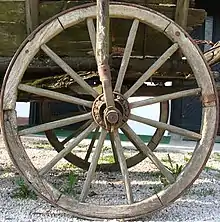
A wheel.
Nom commun
| Singulier | Pluriel |
|---|---|
| wheel \ʍiːl\ |
wheels \ʍiːlz\ |
wheel \ʍiːl\
- Roue.
— Wheel of morality turn turn turn, tell us the lesson that we should learn.
— (Animaniacs (1993–1998))- — Roue de la moralité tourne tourne tourne, et dis-nous de quoi il retourne.
Dérivés
- steering wheel (volant de voiture)
- wheelchair
- wheeler
- wheelie
- wheelman (« conducteur, cycliste »)
Verbe
| Temps | Forme |
|---|---|
| Infinitif | to wheel \ʍiːl\ |
| Présent simple, 3e pers. sing. |
wheels \ʍiːlz\ |
| Prétérit | wheeled \ʍiːld\ |
| Participe passé | wheeled \ʍiːld\ |
| Participe présent | wheeling \ʍiːl.ɪŋ\ |
| voir conjugaison anglaise | |
wheel \ʍiːl\
Prononciation
- \ʍiːl\
- États-Unis : écouter « wheel [ʍiːl] »
- Suisse (Genève) : écouter « wheel [Prononciation ?] »
- France (Saint-Maurice-de-Beynost) : écouter « wheel [Prononciation ?] »
- Royaume-Uni (Londres) : écouter « wheel [Prononciation ?] »
- Connecticut (États-Unis) : écouter « wheel [Prononciation ?] »
Cet article est issu de Wiktionary. Le texte est sous licence Creative Commons – Attribution – Partage à l’identique. Des conditions supplémentaires peuvent s’appliquer aux fichiers multimédias.